
What Is Custom Jewelry? Meaning, Types, Process & Benefits
Table of Contents
Custom jewelry is jewelry that is designed, modified, or produced according to specific requirements rather than being selected entirely from a standard, ready-made design. Depending on the project, customization can involve the shape, dimensions, metal, gemstones, engraving, finish, or other design details.
For an individual buyer, custom jewelry can be a way to create a piece around a personal idea, occasion, or preference. For jewelry brands, designers, retailers, and wholesale buyers, it can also mean developing an original design for sampling and production.
The level of customization can vary significantly. A customer may make a small change to an existing design, create a personalized piece with a name or date, or develop a completely new jewelry design from a sketch or reference.
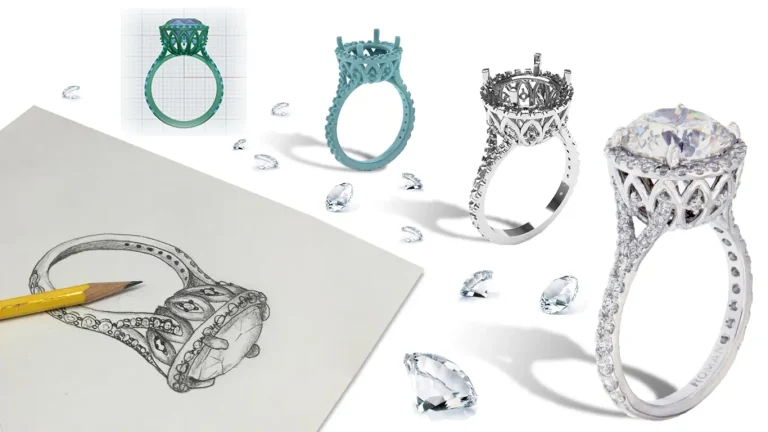
What Is Custom Jewelry?
Custom jewelry is jewelry created or modified to meet a customer’s specific design or production requirements.
Unlike ready-made jewelry, which is produced from a predetermined design, custom jewelry starts with some form of customization. This may be as simple as changing a size or finish or as extensive as developing a new piece from an original concept.
A custom jewelry project may involve:
- An original sketch or design concept
- Changes to an existing jewelry design
- Specific dimensions or proportions
- A particular metal or material
- Customer-supplied or specified gemstones
- Engraving or other personalization
- A specific surface finish or plating
- Custom packaging for a jewelry brand
- Production to an agreed specification and quantity
The term “custom jewelry” therefore covers a range of projects rather than one specific type of jewelry.
What Does Custom Jewelry Mean?
When people ask “what does custom jewelry mean?”, they are usually asking how custom jewelry differs from jewelry that is already designed and produced for general sale.
The key difference is design or production according to specific requirements.
For example, a ready-made necklace may be selected directly from a manufacturer’s existing collection. A custom necklace could use the same general style but have a different pendant shape, chain length, metal, gemstone, or finish.
For a jewelry brand, customization can go further. A manufacturer may develop a new design from a drawing, reference image, CAD file, physical sample, or design brief before producing prototypes and finished pieces.
This is why “custom jewelry” should not automatically be treated as synonymous with “personalized jewelry.” Personalization is one form of customization, but custom jewelry can involve much broader design and manufacturing changes.
What Counts as Custom Jewelry?
Not every customized-looking product involves the same level of design work. It is useful to distinguish several common categories.
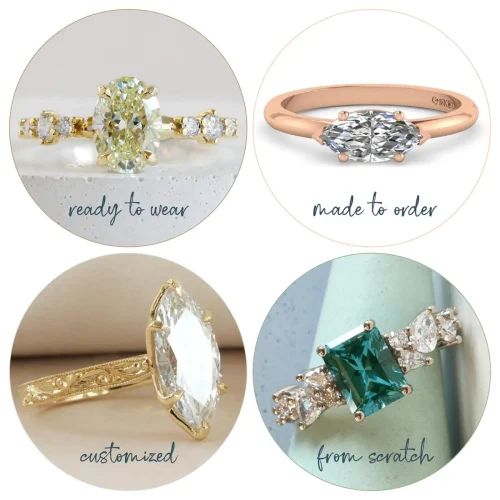
Ready-Made Jewelry
Ready-made jewelry is produced from an existing design and offered as a finished product. Buyers generally select from available styles, sizes, materials, and variations. There is little or no modification to the original design.
Personalized Jewelry
Personalized jewelry adds an individual element to an existing design.
Examples include:
- Names
- Initials
- Dates
- Short messages
- Birthstones
- Engravings
Personalization can therefore be considered a relatively simple form of customization.
Semi-Custom Jewelry
Semi-custom jewelry starts with an existing design but allows selected elements to be changed.
For example, a buyer might choose:
- A different gemstone
- Another metal
- A different finish
- A modified size
- A different engraving
- A slightly altered design element
This approach can provide customization without requiring an entirely new design.
Fully Custom Jewelry
Fully custom jewelry is developed around a specific design concept or set of requirements. A project may begin with a sketch, reference image, mood board, CAD file, or verbal description. The design can then be developed, reviewed, prototyped, and manufactured according to the approved specifications.
Custom Jewelry Manufacturing
For brands and wholesale buyers, custom jewelry can also refer to the development and production of jewelry specifically for a business.
This may involve original designs, CAD development, prototypes, material selection, production quantities, finishing, quality control, packaging, and repeat orders. For a deeper look at the factory-side process, see our guide to custom jewelry manufacturing.
Custom Jewelry vs. Personalized Jewelry
Custom jewelry and personalized jewelry overlap, but they are not exactly the same. Personalized jewelry usually modifies an existing design by adding an individual detail such as a name, date, initial, or birthstone. Custom jewelry can include personalization, but it can also involve changes to the actual design, construction, dimensions, materials, or manufacturing specifications.
For example:
| Type | Typical Customization |
|---|---|
| Ready-made | No design changes |
| Personalized | Name, date, initial, birthstone, engraving |
| Semi-custom | Selected design or material changes |
| Fully custom | New design developed for specific requirements |
| Custom manufacturing | Custom design developed for production at an agreed specification |
The distinction matters particularly for businesses sourcing jewelry. A personalized product may require a simple production modification, while a fully custom design may require CAD development, prototyping, tooling, and additional production work.
What Are the Main Types of Custom Jewelry?
Custom jewelry can be made in almost any jewelry category. The customization is defined more by the design and production requirements than by the type of jewelry itself.
Custom Rings
Custom rings may be developed around a specific shape, stone, setting, width, engraving, or metal. Engagement rings, wedding rings, signet rings, statement rings, and branded fashion rings can all be produced as custom designs.
Custom Necklaces
Custom necklaces can involve changes to the pendant, chain, dimensions, gemstone arrangement, metal, plating, or finishing. For brands, a custom necklace can also be developed as part of a larger collection with consistent design elements.
Custom Bracelets
Custom bracelets may be developed around specific dimensions, link structures, charms, stones, closures, or surface finishes.
Custom Earrings
Custom earrings can range from relatively simple modifications to completely original designs involving multiple components, stones, finishes, and construction requirements.
Custom Jewelry for Brands and Wholesale Buyers
For jewelry brands and wholesale buyers, customization often means creating products that fit a specific brand identity or collection rather than simply selecting an existing catalog item.
A project may start with:
- A hand-drawn sketch
- A reference image
- A CAD file
- A physical sample
- A design specification
- A collection concept
The manufacturer can then help translate the approved concept into a production-ready jewelry design.
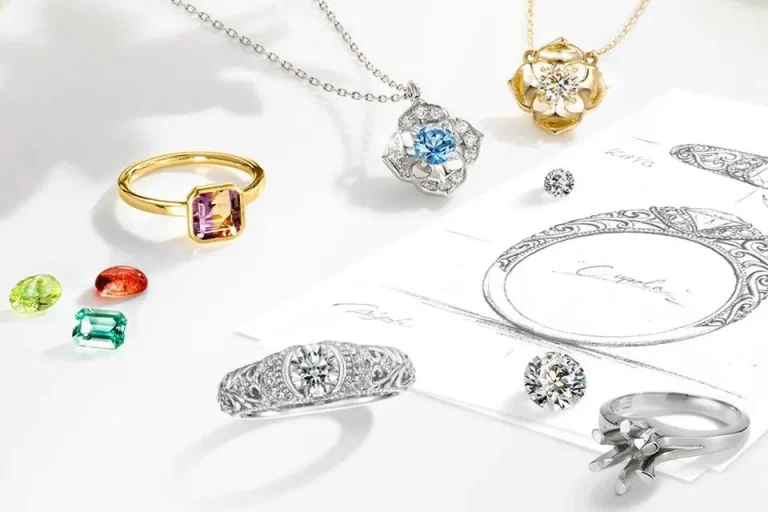
How Is Custom Jewelry Made?
The production process depends on the design and material, but many custom jewelry projects follow a sequence such as:
- Design brief or concept review
- CAD development
- Design revisions and approval
- Prototype or 3D printing
- Casting or other manufacturing processes
- Assembly and surface finishing
- Gemstone setting when required
- Polishing and plating
- Quality control
- Packaging and shipping
Modern jewelry production can combine traditional craftsmanship with digital technologies. CAD/CAM and 3D printing are now used in jewelry design and manufacturing education, including programs offered by the Gemological Institute of America (GIA). GIA’s jewelry design and technology program covers CAD design, prototyping, 3D printing, and manufacturing considerations.
The exact workflow varies according to the design, material, production method, quantity, and finishing requirements. If you want to understand the production stages in more detail, see our guide to how custom jewelry is made.
What Are the Benefits of Custom Jewelry?
The benefits of custom jewelry depend on the project, but customization can provide several practical advantages.
More Control Over the Design
Custom production gives buyers or brands greater control over design elements that may not be available in a standard collection. This can include dimensions, proportions, materials, stones, finishes, and other specifications.
A More Distinctive Product
For jewelry brands, developing an original design can help create products that are different from widely available catalog styles. This can be particularly useful when building a collection around a specific brand identity.
Flexibility in Materials and Finishing
Depending on the manufacturer’s capabilities, a custom project may allow the buyer to specify the metal, gemstone, plating, surface finish, or other production details. The available options depend on the manufacturer’s equipment, expertise, material sourcing, and production capabilities.
Better Fit for Specific Requirements
Custom jewelry can be designed around requirements that standard products cannot easily accommodate. For example, a buyer may need a particular pendant size, chain length, stone arrangement, packaging specification, or production quantity.
Personal and Emotional Value
For individual customers, customization can also add personal meaning. Names, dates, symbols, birthstones, family designs, and other details can turn a jewelry piece into a personal keepsake.
For businesses, however, the value of customization is often more practical: product differentiation, collection development, brand consistency, and control over specifications.
How Much Does Custom Jewelry Cost?
There is no single price for custom jewelry because the cost depends on the project.
Important cost factors can include:
- Jewelry type
- Metal and material
- Finished weight
- Gemstones
- Design complexity
- CAD and engineering requirements
- Prototyping
- Production quantity
- Surface finishing and plating
- Packaging
- Quality-control requirements
A simple modification to an existing design may require much less development work than a completely new jewelry design. For brands and wholesale buyers, quantity can also affect unit economics because design and development costs may be distributed across multiple pieces.
Instead of assuming that custom jewelry is always more or less expensive than ready-made jewelry, it is more useful to evaluate the actual specifications and production requirements. For a more detailed breakdown, see our custom jewelry cost guide.
What Materials Can Be Used for Custom Jewelry?
Custom jewelry can be produced using different metals, gemstones, and finishing options depending on the design and manufacturer’s capabilities.
Common jewelry materials include:
- 925 sterling silver
- Brass
- Gold and gold alloys
- Gold-plated metals
- Vermeil
- Various gemstones and decorative materials
The appropriate material depends on factors such as design requirements, target price, appearance, durability, production method, and intended market. When a jewelry product is marketed using claims about precious metals, gemstones, quality, or other material characteristics, those descriptions should be accurate and clear.
The U.S. Federal Trade Commission’s Jewelry Guides provide guidance on truthful representations of jewelry, precious metals, gemstones, pearls, and related product characteristics. FTC’s Jewelry Guides are a useful reference for businesses selling into the U.S. market. If your project focuses specifically on silver, see our complete guide to custom silver jewelry.
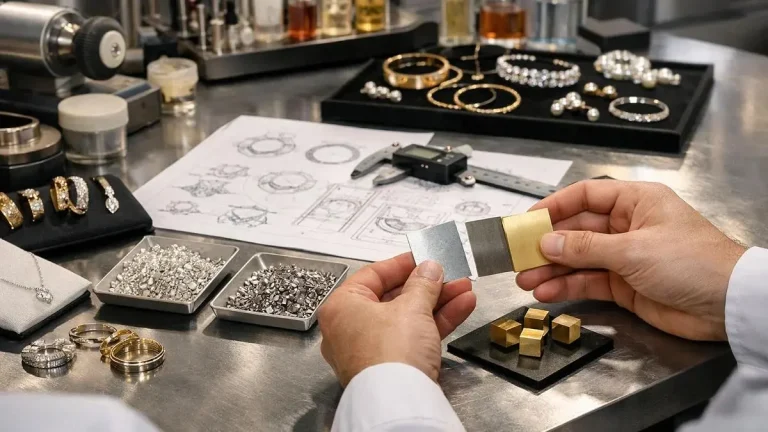
How Do You Start a Custom Jewelry Project?
A custom jewelry project usually becomes easier when the requirements are clearly defined before production begins. A buyer or brand should consider:
1. Define the Design
Provide a sketch, reference image, existing sample, CAD file, or written design brief. The clearer the starting information, the easier it is for a manufacturer to understand the intended result.
2. Specify Materials
Identify the preferred metal, gemstones, plating, finish, and any other material requirements. If you already have gemstones or other materials, confirm whether the manufacturer can work with customer-supplied materials before production.
3. Confirm Dimensions and Specifications
Dimensions, weight, stone size, chain length, thickness, closures and other technical details can affect both production and cost.
4. Review the Prototype or Sample
For original designs, a CAD rendering or physical prototype can help identify design issues before larger-scale production.
5. Confirm Production Requirements
For B2B projects, confirm quantity, packaging, quality requirements, delivery expectations, and any other production specifications before placing the order. A clear specification helps both the buyer and manufacturer reduce misunderstandings during production.
What Should You Look for in a Custom Jewelry Manufacturer?
Choosing a manufacturer is different from choosing a retail jeweler. For brands, designers, and wholesale buyers, useful factors to evaluate include:
- Experience with the required jewelry category
- Relevant material capabilities
- CAD and sampling capabilities
- Ability to work from drawings or reference samples
- Communication during development
- Production capacity
- Quality-control procedures
- Packaging capabilities
- MOQ and quantity flexibility
- Ability to support repeat production
It is also useful to ask how the manufacturer handles design revisions, prototypes, material confirmation, quality control, and production approval.
A manufacturer should be able to explain what it can produce, what information it needs from the buyer, and which parts of the project may require additional development. For a more detailed explanation of the B2B process, see our guide to custom jewelry manufacturing.

Conclusion
Custom jewelry is not limited to one particular style or type of product. It describes jewelry that is designed, modified, or produced according to specific requirements. The level of customization can range from simple personalization to semi-custom modifications, fully original designs, and complete custom manufacturing for jewelry brands.
For individual buyers, customization can provide greater control over the design and personal meaning. For jewelry businesses, it can provide greater control over product specifications, collection development, materials, and brand identity. The most important step is to define what you actually need before production begins. Once the design, materials, dimensions, quantity, and finishing requirements are clear, you can choose an appropriate production method and manufacturing partner.
FAQs
1. What makes custom jewelry different from mass-produced jewelry?
Custom jewelry is designed or modified according to specific requirements, while mass-produced jewelry is manufactured from predetermined designs for broader distribution. Customization can involve the design, dimensions, materials, gemstones, engraving, finishing, or other specifications.
2. Is custom jewelry more expensive than ready-made jewelry?
Not necessarily. The cost depends on factors such as materials, finished weight, design complexity, gemstones, CAD and prototyping requirements, production quantity, finishing, and other project specifications. A simple customization may require much less development work than a completely new design.
3. How long does it take to make custom jewelry?
There is no universal production timeline for custom jewelry. The schedule can vary depending on design complexity, CAD revisions, prototype requirements, material availability, production quantity, finishing, and quality-control requirements. A manufacturer should confirm the expected timeline based on the specific project.
4. Can I use my own gemstones or materials for a custom jewelry design?
Depending on the project and manufacturer’s capabilities, customer-supplied gemstones or specified materials may be incorporated into a custom jewelry design. This should be confirmed before sampling and production, including requirements for material inspection, dimensions, compatibility, and handling.
5. How do I choose the right custom jewelry manufacturer?
Look for a manufacturer with relevant production experience, material capabilities, CAD and sampling support, clear communication, quality-control procedures, and experience with your required quantity and product type. For B2B projects, it is also useful to confirm MOQ, packaging, production timelines, and repeat-order capabilities before starting production.

Samuel
With 15+ years of hands-on experience, Samuel specializes in jewelry materials, plating, gemstones, production, and quality control, sharing practical insights from real-world manufacturing.


