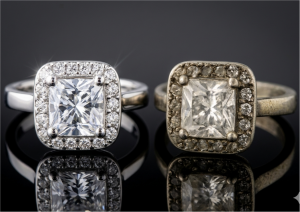
“My CZ ring turned black after six months. Does this mean it’s low quality?” This is perhaps the most frequently asked question in the jewelry industry. When your favorite piece of jewelry loses its luster, it’s natural to feel disappointed and assume the “gem” has failed.
First, the short answer: The Cubic Zirconia (CZ) stone itself does not oxidize or “tarnish.” This lab-created crystal is chemically inert and incredibly stable. So, why does your jewelry look dull, green, or black? From a manufacturer’s perspective, over 80% of tarnish issues are caused by poor plating—not the CZ stone itself. The “tarnish” you see is almost always a reaction of the metal setting or a buildup of environmental residue. This comprehensive guide will dissect the science of CZ and identify the true causes of discoloration.
What Exactly Is Cubic Zirconia Made Of?
Understanding the composition of CZ is the first step in debunking the tarnish myth. Cubic Zirconia is a synthetic crystalline material made from Zirconium Dioxide (ZrO2).
Unlike natural gemstones formed in the earth’s crust with various impurities, CZ is grown in highly controlled laboratory environments at temperatures exceeding 2,750°C.
The Chemical Stability of ZrO2
Because CZ is a pure oxide, it lacks the metallic elements required for oxidation. It does not react with oxygen, water, or most household chemicals. This makes the stone itself “tarnish-proof.” Whether you wear it in the rain or leave it on a shelf for a decade, the chemical structure of the ZrO2 crystal remains unchanged.
Comparative Analysis: CZ vs. Diamond
| Feature | Cubic Zirconia (CZ) | Natural Diamond |
|---|---|---|
| Chemical Formula | Zirconium Dioxide (ZrO2) | Pure Carbon (C) |
| Mohs Hardness | 8.0 – 8.5 (Highly Durable) | 10 |
| Refractive Index | 2.15 – 2.18 | 2.42 |
| Dispersion (Fire) | 0.058 – 0.066 (Higher fire) | 0.044 |
| Chemical Reactivity | Inert / Non-reactive | Inert / Non-reactive |


Does Cubic Zirconia Tarnish or Change Color?
Let’s clear the air: If your stone looks like it has “turned black,” it hasn’t. It is experiencing external issues that are often mislabeled as tarnishing.
1. The “Cloudy” Effect (Surface Buildup)
CZ is a “lithophilic” material, meaning it has a natural affinity for oils. Every time you touch your stone, you leave behind microscopic layers of skin oil. Combined with lotions and hairspray, this creates a “cloudy” film that kills the stone’s refractive “fire.”
2. Metal Oxidation (The Real Enemy)
When people ask, “Does cubic zirconia turn green?”, they are actually asking about the metal.
- Sterling Silver (925): Reacts with sulfur in the air to create black tarnish.
- Brass/Copper Bases: React with skin acidity to produce the “green finger” effect.
Because the stone is translucent, the dark tarnish on the metal reflections through the stone, making the CZ appear discolored.
How to Prevent Tarnish and Keep Your CZ Sparkling?
Prevention is significantly more effective than restoration. To ensure your jewelry maintains its “Day 1” glow, follow these professional maintenance protocols.
The “Last On, First Off” Rule
Chemicals are the primary enemy of jewelry plating. Always apply your perfume, lotion, and hairspray before putting on your jewelry.
Environmental Safeguards
- No Swimming: Chlorine and salt are highly corrosive to the rhodium or gold plating.
- Dry Storage: Moisture is a catalyst for oxidation. Store your CZ pieces in individual airtight bags or a fabric-lined jewelry box.
- Sweat Management: Human sweat contains urea and chlorides. If you wear your CZ during a workout, the acidity can strip the protective plating within weeks.
Restoring the Shine: Cleaning and Repair
If your jewelry has already lost its luster, it may be reversible.
For Dirty or Cloudy Stones (The Soap Soak)
- Soak: Submerge in warm water with mild dish soap for 20 minutes.
- Brush: Use a soft-bristled toothbrush to gently scrub behind the stone.
- Dry: Pat dry with a lint-free microfiber cloth.
For Heavy Metal Tarnish (Professional Re-plating)
If the base metal has turned black or green, home cleaning won’t help. The protective plating has worn off. A professional jeweler can perform Rhodium Plating to restore the original shine.

How Long Does Cubic Zirconia Last?
A high-quality CZ stone can technically last a lifetime, but the jewelry piece has a functional lifespan dictated by its construction.
- Fast Fashion Quality: (Thin plating, copper base) – 3 to 6 months.
- Standard Retail Quality: (Gold vermeil or Sterling Silver) – 1 to 3 years.
- High-End Manufacturer Quality: (Thick 0.3+ micron plating, AAAAA stones) – 5 to 10+ years.
Buyer’s Guide: Choosing Quality That Stays Beautiful
If you want your jewelry to stay bright, you must focus on the manufacturer’s standards.
1. Demand 5A (AAAAA) Grade Stones
CZ is graded from A to AAAAA. 5A stones are hand-cut and polished to the same proportions as an Ideal Cut diamond.
2. Verify Plating Thickness (The Critical Factor)
Look for manufacturers that specify Rhodium Plating or Gold Plating with a thickness of at least 0.3 microns. This “armor” is what truly prevents the appearance of tarnish.
3. Base Metal Integrity
Always choose 925 Sterling Silver or Stainless Steel as a base. Avoid “brass” or “alloy,” as these are guaranteed to tarnish once the thin plating wears thin.
Final Note for Jewelry Brands
While proper care can extend the life of cubic zirconia jewelry, the real difference always comes from manufacturing quality. If you are sourcing jewelry for your brand, working with an experienced manufacturer ensures better plating, longer-lasting shine, and fewer customer complaints.
Endless Jewelry provides custom CZ jewelry manufacturing with reliable quality and scalable production support. Whether you are looking for superior plating durability or high-grade stone setting, we understand the science behind long-lasting brilliance.
Contact us to learn more about our OEM/ODM services and how we can help your brand shine.
Conclusion
To summarize: Cubic Zirconia does not tarnish. The dullness you see is either a “mask” of dirt or the “decay” of the metal setting due to substandard manufacturing. By investing in high-quality materials and a disciplined care routine, you can enjoy the prestige of a diamond at a fraction of the cost.