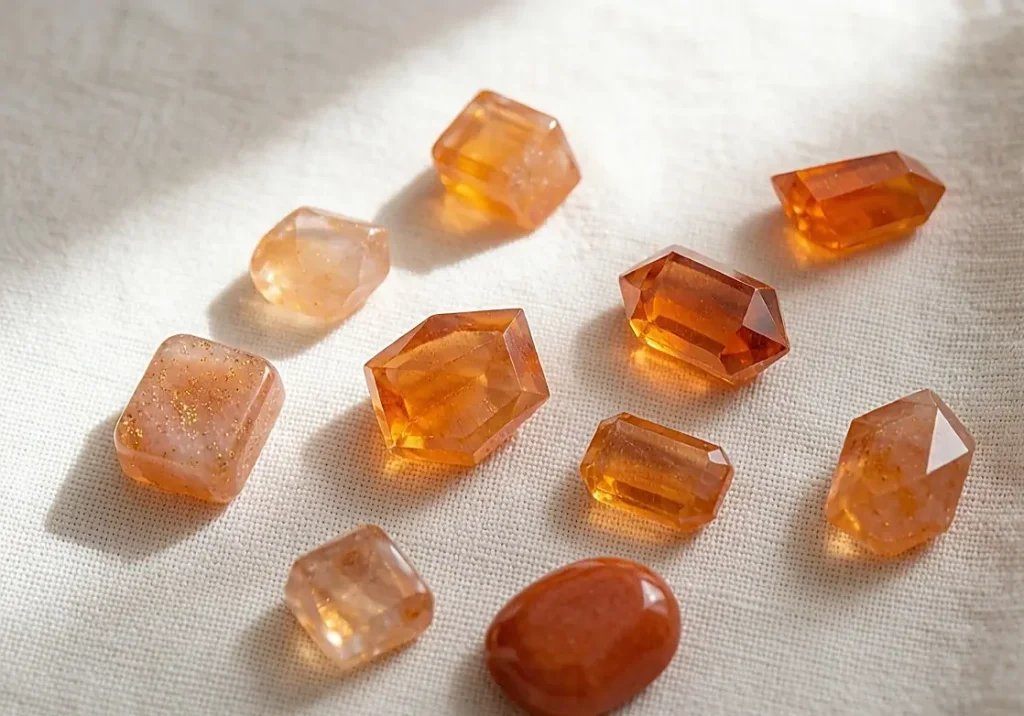
Orange gemstones range from vivid mandarin and fiery red-orange to soft peach, golden yellow-orange, and warm burnt orange. The most popular types of orange gemstones include orange sapphire, spessartite garnet, imperial topaz, citrine, fire opal, orange spinel, orange tourmaline, orange zircon, sunstone, carnelian, hessonite garnet, orange moonstone, amber, coral, and orange andesine/labradorite. These stones differ significantly in hardness, toughness, rarity, treatment, price, and suitability for jewelry. For everyday rings, orange sapphire, orange spinel, topaz and garnet are generally more practical choices than softer stones. Fire opal, moonstone, amber, coral, and sunstone are often better suited to earrings or pendants with protective settings.
What Are Orange Gemstones?
Orange gemstones are natural or treated gem materials that display orange as their dominant body color or optical appearance. There is no single mineral called an “orange gemstone.” Instead, orange occurs across many different gemstone families, including corundum, garnet, quartz, topaz, opal, spinel, tourmaline, zircon, feldspar, chalcedony, and organic gem materials.
The reason gemstones appear orange depends on their chemical composition, crystal structure, inclusions, and optical properties. In some materials, trace elements such as iron influence color. In others, color may be modified or intensified through heat treatment or other treatments.
For jewelry buyers, identifying the type of orange gemstone is important because two stones can look similar but behave very differently during manufacturing and wear. For example, orange sapphire has a Mohs hardness of 9 and excellent durability, while amber is only about 2–2.5 and can be scratched easily. GIA emphasizes that gemstone durability depends on more than hardness alone; toughness and stability against heat, chemicals, light, and humidity also matter.
What Causes a Gemstone to Look Orange?
Several factors can create an orange appearance:
- Trace elements: Elements such as iron can influence the absorption of light and create yellow, orange, brown, or reddish colors.
- Crystal structure: The arrangement of atoms within a gemstone affects how light is absorbed and transmitted.
- Inclusions: Internal minerals, platelets, liquids, or other inclusions can create or modify a gemstone’s visual appearance.
- Optical effects: Phenomena such as aventurescence, adularescence, or play-of-color can make an orange gemstone appear brighter or more dynamic.
- Treatment: Heat treatment, irradiation, dyeing, impregnation, or other processes can modify the color of some gemstones.
Citrine is a useful example. GIA identifies citrine as the transparent pale-yellow to brownish-orange variety of quartz and notes that iron in its structure is responsible for its yellow-to-orange color. Natural citrine is relatively rare, and much of the citrine on the market is produced by heat treatment of amethyst.
Orange Gemstone Color Ranges
Orange gemstones are not limited to one shade. Common color descriptions include:
- Yellow-orange: Bright and warm, often seen in citrine and some topaz.
- Golden orange: A rich yellow-orange with a warm metallic appearance.
- Peach orange: Softer orange with pink or pale undertones, common in spinel and tourmaline.
- Vivid orange: Strong, saturated orange with little brown or gray.
- Reddish orange: Orange with noticeable red undertones.
- Burnt orange: Deeper orange with brown or red undertones.
For jewelry manufacturing, color consistency is particularly important when multiple stones are used in one piece. A single orange stone may look attractive by itself but appear mismatched when placed beside stones with different saturation, tone, or secondary colors.
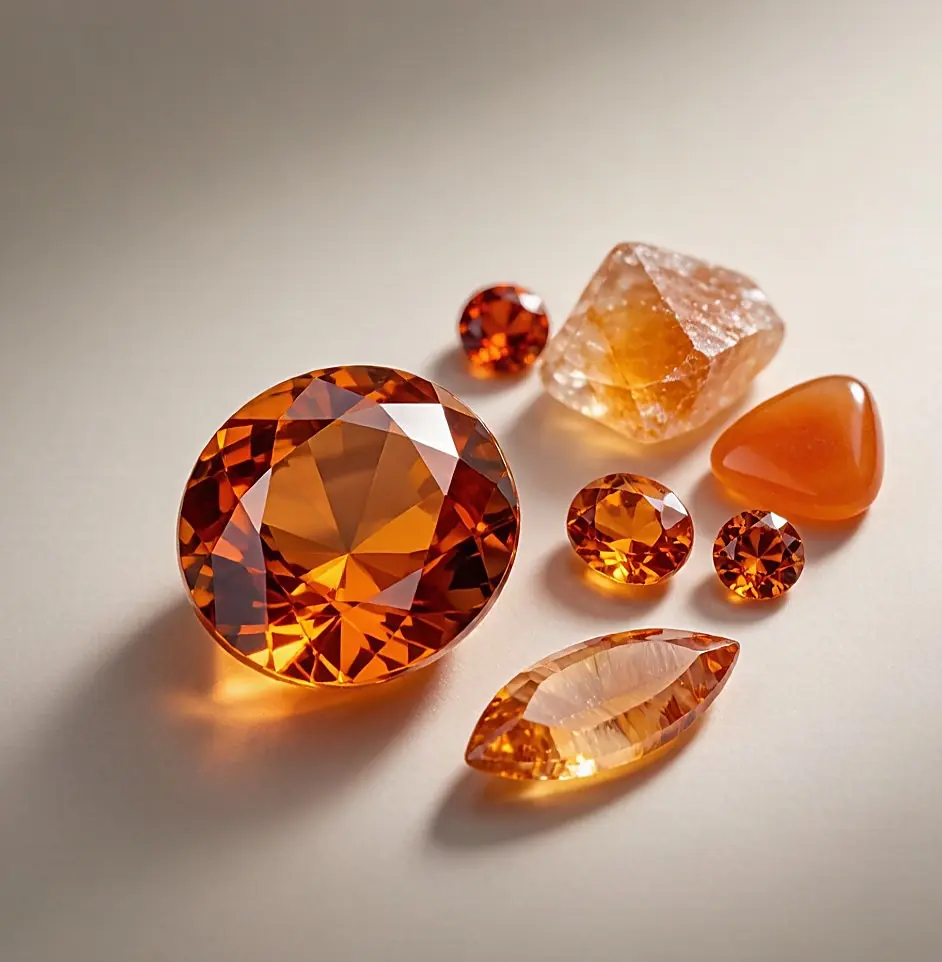
15 Types of Orange Gemstones You Should Know
If you are researching types of orange gemstones, these are 15 important materials to understand:
- Orange Sapphire
- Spessartite Garnet
- Imperial Topaz
- Citrine
- Fire Opal
- Orange Spinel
- Orange Tourmaline
- Orange Zircon
- Sunstone
- Carnelian
- Hessonite Garnet
- Orange Moonstone
- Amber
- Orange Coral
- Orange Andesine / Labradorite
The stones below are arranged as a practical guide rather than a strict ranking because the “best” orange gemstone depends on the intended jewelry design, budget, durability requirements, and desired appearance.
1. Orange Sapphire
Orange sapphire is one of the most durable orange colored gemstones available for jewelry. Sapphire is a variety of corundum and, like ruby, ranks 9 on the Mohs hardness scale. For a closer comparison of these two corundum gemstones, see our guide to ruby vs sapphire. GIA describes corundum as having excellent toughness and no cleavage, making sapphire suitable for rings and other jewelry exposed to daily wear.
Orange sapphires can range from yellow-orange and peachy orange to vivid reddish-orange. Their color can be influenced by trace elements and, depending on the stone, treatment may be used to improve or modify the appearance.
From a manufacturing perspective, sapphire is attractive because its hardness and toughness provide a relatively wide range of setting options. It can be used in rings, earrings, pendants, bracelets, and other jewelry designs.
For high-value orange sapphire, buyers should ask whether the color is natural or treated and whether the stone has an independent laboratory report. Color quality, clarity, origin, size, and treatment can create major differences in value.
2. Spessartite Garnet
Spessartite garnet is famous for its bright mandarin-orange color. Fine examples can show an intense, saturated orange with strong brilliance, making them particularly attractive in statement rings, earrings, and pendants.
Garnet varieties generally fall within a Mohs hardness range of 6.5–7.5. GIA notes that garnets have fair to good toughness and can be suitable for different jewelry styles when handled appropriately.
Spessartite is especially interesting for buyers who want a vivid orange color without choosing sapphire. Its color can be more immediately recognizable as “orange,” while its brilliance works well with faceted cuts.
For manufacturers, sourcing consistency is important. Matching stones by orange hue, saturation, clarity, and calibrated dimensions can become more difficult as stone size increases. This is particularly relevant when developing earrings or multi-stone collections.
3. Imperial Topaz
Imperial topaz is associated with warm golden-orange, orange-pink, peach, and reddish-orange colors. High-quality material can be highly attractive because of its strong color and transparency.
Topaz has a Mohs hardness of 8, but hardness should not be confused with toughness. GIA notes that topaz has poor toughness because of its cleavage, meaning a strong impact can cause the stone to split or break.
This affects jewelry design. Imperial topaz can be used in rings, but the setting should provide appropriate protection. Protective bezels or carefully designed prongs can reduce exposure to impacts.
Topaz can also undergo treatments, including heat treatment and irradiation. Buyers should therefore ask about treatment before comparing stones by price.
For manufacturing, the main consideration is not simply “Is topaz hard enough?” but rather “Where is the stone vulnerable?” During cutting, setting, polishing, and final inspection, excessive pressure or impact around vulnerable areas can create unnecessary production loss.
4. Citrine
Citrine is one of the most accessible orange-to-yellow gemstones for jewelry. It is a quartz variety that ranges from pale yellow to brownish orange, with earthy deep orange and reddish-orange shades being particularly popular. GIA describes citrine as the top-selling yellow-to-orange gem because it combines attractive color, durability, and affordability.
Citrine has a Mohs hardness of 7, making it suitable for many jewelry applications when properly designed and worn. It works particularly well in rings, necklaces, earrings, bracelets, and fashion jewelry.
One important distinction is natural versus treated citrine. Natural citrine is rare, while much commercial citrine results from heat treatment of amethyst. This does not automatically make treated citrine undesirable, but the treatment should be disclosed when relevant.
For wholesale collections, citrine is often practical because it can provide a warm orange appearance at a relatively accessible price level. It is also available in different sizes and cuts, giving designers flexibility when developing commercial collections.
5. Fire Opal
Fire opal is known for its orange, yellow, or red body color and can sometimes display play-of-color. Mexican fire opal is particularly well known, although fire opal also occurs in other locations.
Fire opal is softer and more vulnerable than sapphire, spinel, or topaz. GIA gives opal a Mohs hardness of approximately 5.5–6.5 and notes that opal contains water and should not be allowed to dry too rapidly because cracking can occur.
For this reason, fire opal is often a better choice for earrings and pendants than for rings intended for constant daily wear.
From a design perspective, the stone’s body color and any play-of-color can create a strong visual effect even when the stone is not extremely large. Cabochon cuts are common for some fire opal designs, while transparent material may also be faceted.
Protective settings are recommended when designing jewelry around fire opal. The goal is to reduce direct impact on the stone while allowing enough of the orange body color to remain visible.
6. Orange Spinel
Orange spinel can range from peach and soft orange to vivid orange and reddish-orange. Fine natural orange spinel is relatively uncommon, which makes it particularly interesting for collectors and designers looking beyond conventional sapphire and garnet.
Spinel ranks 8 on the Mohs scale and has good toughness, according to GIA, making it a durable choice for a wide range of jewelry.
Orange spinel can therefore be an excellent option for rings when the buyer wants a durable gemstone with a less conventional appearance.
Natural and untreated material can be especially appealing in the fine gemstone market. However, some spinel can receive treatments, so treatment disclosure remains important.
From a manufacturer’s perspective, spinel offers a useful combination of durability and color. The challenge is often sourcing enough stones with closely matched color and dimensions for larger production quantities.
7. Orange Tourmaline
Orange tourmaline can display peach, orange, pinkish-orange, brownish-orange, or reddish-orange tones. One of its interesting characteristics is pleochroism, meaning the gemstone can show different body colors depending on the viewing direction.
Tourmaline generally ranks 7–7.5 on the Mohs scale and has fair toughness. GIA recommends avoiding high heat because it can alter color, while sudden temperature changes can cause fracturing.
Orange tourmaline works well in earrings, pendants, rings, and statement jewelry. Long or rectangular cuts can emphasize the stone’s color zoning and optical characteristics.
When selecting orange tourmaline for production, color direction matters. Two stones with the same nominal color may look different once mounted because their pleochroism interacts with the direction of the cut and the viewing angle.
8. Orange Zircon
Orange zircon is a natural gemstone rather than a synthetic diamond substitute, despite the occasional confusion caused by the word “zircon.” It can show yellow-orange, orange, brownish-orange, and reddish-orange hues.
Zircon is valued for its high brilliance and strong optical properties. Its hardness is commonly around 6.5–7.5, depending on the material, and it can be somewhat brittle. GIA notes that zircon requires care because it is not as hard or durable as some other jewelry stones and may be vulnerable when used as a ring stone.
Orange zircon can be especially attractive in faceted cuts because its brilliance helps create lively flashes of light.
For rings, a protective setting and appropriate stone orientation are important. For earrings and pendants, the risk of impact is generally lower, making zircon easier to incorporate into designs.
9. Sunstone
Sunstone belongs to the feldspar family and can show orange, red-orange, peach, and golden colors. Its most recognizable optical feature is aventurescence, a glittering effect caused by reflective inclusions.
Oregon sunstone is particularly well known, and different varieties can display different colors and inclusion patterns.
Sunstone has a hardness of approximately 6.5–7.2, but GIA points out that feldspar’s cleavage and relatively poor toughness can make the material vulnerable to damage. Protective settings such as pendants and earrings are therefore often preferable to rings.
For manufacturers, the inclusions that create aventurescence are part of the stone’s visual appeal, but they also need to be considered during cutting and setting. A design that applies excessive pressure to a heavily included stone can increase breakage risk.
10. Carnelian
Carnelian is an orange to reddish-orange variety of chalcedony, which belongs to the quartz family. It is commonly translucent to opaque and is frequently cut as cabochons, beads, or simple faceted stones.
Its orange color can range from light orange to deep red-orange and brownish orange. Because the material can have a relatively even appearance, carnelian is practical for larger fashion jewelry designs and coordinated collections.
Carnelian generally has a Mohs hardness of around 6.5–7, making it harder than many organic orange gem materials. However, it should still be protected from strong impacts and scratches from harder gemstones.
Historically, carnelian has been widely used in beads, seals, carved jewelry, pendants, and decorative objects. In modern jewelry manufacturing, it works particularly well in bold cabochon designs, vintage-inspired pieces, men’s jewelry, and affordable gemstone collections.
11. Hessonite Garnet
Hessonite is a variety of grossular garnet that commonly shows honey-orange, cinnamon-orange, yellow-orange, and brownish-orange colors.
Like other garnets, hessonite generally falls within the broader 6.5–7.5 Mohs hardness range for the garnet group.
One characteristic buyers may notice is its internal appearance. Hessonite can contain distinctive inclusions that sometimes create a slightly “roiled” or hazy visual effect. In some gemstones, these internal characteristics are part of the identity of the material rather than simply defects.
Hessonite works well in rings, earrings, and pendants when appropriately protected. It is particularly useful for designs that need a warm cinnamon or honey-orange appearance rather than the intense mandarin orange associated with fine spessartite.
12. Orange Moonstone
Orange moonstone is a feldspar gemstone displaying warm orange, peach, cream-orange, or brownish-orange body colors. Its appeal comes largely from its soft glow and adularescence rather than high brilliance.
Moonstone has a Mohs hardness of about 6–6.5 and poor toughness. It also has two cleavage directions, which can make it vulnerable to breakage from hard impacts. GIA therefore notes that manufacturers commonly use moonstone in pendants, earrings, and pins rather than high-impact ring designs.
Cabochon cutting is particularly effective because it allows the optical glow to spread across the curved surface.
For orange moonstone jewelry, protective settings are useful. The stone should also be protected from high heat and sudden temperature changes.
13. Amber
Amber is fundamentally different from most mineral gemstones because it is an organic gem material formed from fossilized tree resin.
Its appearance can range from pale yellow and honey to golden orange, reddish orange, and deeper brown-orange. Inclusions such as ancient plant material or insects can add additional interest.
Amber is very soft, with a Mohs hardness of approximately 2–2.5, and it has poor toughness. GIA recommends protecting amber from scratches, heat, and chemicals and cleaning it only with mild warm soapy water.
Amber should therefore not be treated like sapphire or spinel during jewelry production.
It is particularly suitable for pendants, beads, earrings, and protected statement pieces. When designing amber jewelry, the setting should prevent direct contact between the soft material and harder surfaces.
14. Orange Coral
Orange coral is another organic gem material. Unlike transparent crystalline gemstones, coral is typically opaque and has a soft, natural appearance.
GIA describes coral as a relatively soft gem material with a Mohs hardness of approximately 3–4. It can also be porous and sensitive to heat, chemicals, cosmetics, perfumes, and prolonged exposure to sunlight.
Orange coral can be used in beads, cabochons, carved jewelry, pendants, earrings, and decorative pieces.
Treatment is an important consideration. Coral may be dyed, bleached, impregnated with wax, or stabilized with plastic, and these treatments should be disclosed.
For manufacturing, coral needs gentler handling than hard crystalline gemstones. Abrasive polishing, aggressive cleaning, and ultrasonic or steam cleaning should be avoided.
15. Orange Andesine / Labradorite
Orange andesine or orange labradorite refers to feldspar material that can show orange, coppery, brown-orange, or reddish-orange appearances. Some feldspar gems can also display attractive optical effects.
This category deserves particular attention when purchasing because feldspar nomenclature and treatment history can be more complicated than the name on a commercial product listing suggests. Buyers should ask for clear information about the material, origin where relevant, and any treatment.
Depending on the specific material, hardness is generally in the feldspar range rather than the high-hardness range of sapphire or spinel. This means setting design and intended wear should be considered carefully.
Orange feldspar can work well in statement pendants, earrings, cabochon jewelry, and fashion collections where its unusual color and optical appearance are more important than maximum scratch resistance.
Orange Gemstones Comparison Chart
The following comparison is intended as a practical jewelry guide. Price levels are relative rather than fixed because gemstone value can change substantially according to color, clarity, treatment, origin, size, cut, and market demand.
| Gemstone | Color Range | Mohs Hardness | Durability | Typical Treatment | Best Jewelry | Rarity | Price Level |
|---|---|---|---|---|---|---|---|
| Orange Sapphire | Yellow-orange to vivid reddish-orange | 9 | Excellent | Heat treatment may occur | Rings, earrings, pendants | Medium–High | $$$–$$$$ |
| Spessartite Garnet | Mandarin to reddish-orange | 6.5–7.5 | Good | Usually limited | Rings, earrings, pendants | Medium | $$–$$$$ |
| Imperial Topaz | Golden-orange to pinkish-orange | 8 | Good hardness, lower toughness | Heat treatment may occur | Rings, pendants, earrings | High | $$$–$$$$ |
| Citrine | Yellow-orange to deep orange | 7 | Good | Often heat-treated | Rings, earrings, pendants | Low–Medium | $–$$ |
| Fire Opal | Orange, red-orange, yellow-orange | 5.5–6.5 | Moderate | Treatments may occur | Earrings, pendants | Medium | $$–$$$$ |
| Orange Spinel | Peach to vivid orange | 8 | Very Good | Heat treatment may occur | Rings, earrings, pendants | High | $$$–$$$$ |
| Orange Tourmaline | Peach to brown-orange | 7–7.5 | Good | Heat/irradiation may occur | Rings, earrings, pendants | Medium–High | $$–$$$$ |
| Orange Zircon | Orange to yellow-orange | 6.5–7.5 | Moderate | Treatment may occur | Earrings, pendants, protected rings | Medium | $$–$$$ |
| Sunstone | Peach to orange-red | 6.5–7.2 | Moderate | Limited/stone dependent | Earrings, pendants | Medium | $$–$$$ |
| Carnelian | Orange to red-orange | 6.5–7 | Good | May be enhanced | Beads, pendants, rings | Low–Medium | $–$$ |
| Hessonite Garnet | Honey to cinnamon-orange | 6.5–7.5 | Good | Usually limited | Rings, earrings, pendants | Medium | $$–$$$ |
| Orange Moonstone | Peach to orange | 6–6.5 | Moderate–Low | May be treated depending on material | Earrings, pendants | Medium | $$–$$$ |
| Amber | Golden to reddish-orange | 2–2.5 | Low | Dyeing/enhancement may occur | Pendants, earrings, beads | Medium | $–$$$$ |
| Orange Coral | Soft orange to reddish-orange | 3–4 | Low | Dyeing, bleaching, stabilization | Earrings, pendants, beads | Medium–High | $$–$$$$ |
| Orange Andesine/Labradorite | Orange to brown-orange | ~6–6.5 | Moderate | Treatment may occur | Pendants, earrings | Medium | $$–$$$ |
Important: Mohs hardness measures resistance to scratching, not overall durability. Toughness and stability are also important when selecting a gemstone for jewelry.
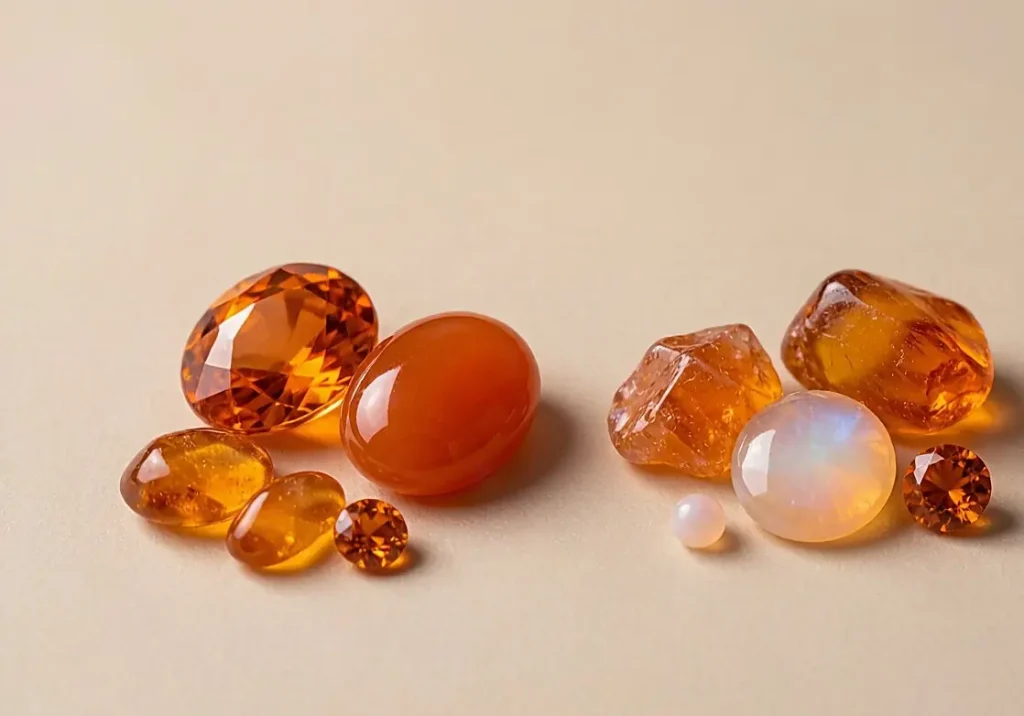
Which Orange Gemstones Are Best for Everyday Jewelry?
For everyday jewelry, hardness alone should not determine the choice. A gemstone needs an appropriate combination of hardness, toughness, stability, and setting design. GIA specifically distinguishes hardness from toughness and stability when evaluating gemstone durability.
A stone with high hardness can still be vulnerable to impact. Topaz, for example, is Mohs 8 but has poor toughness because of cleavage. Conversely, softer stones may be perfectly suitable for earrings or pendants where they receive fewer impacts.
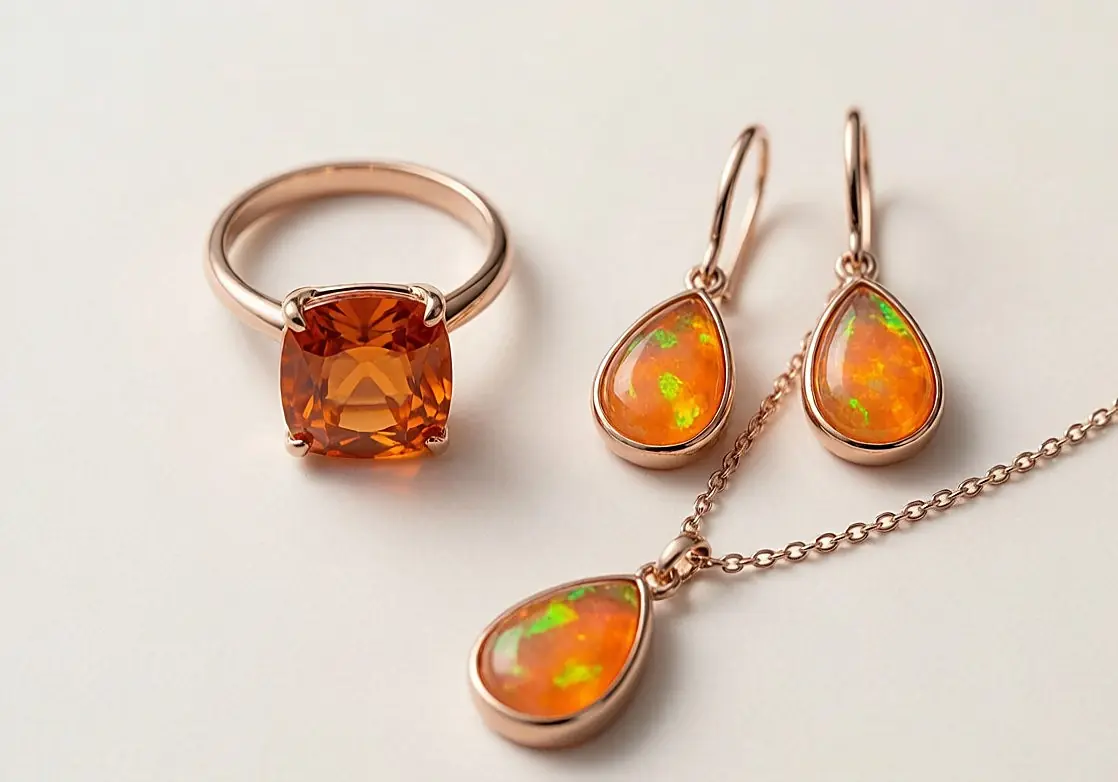
Best Orange Gemstones for Rings
For everyday rings, I would generally prioritize:
- Orange sapphire – excellent hardness and toughness.
- Orange spinel – Mohs 8 with good toughness.
- Imperial topaz – hard but requires protection because of cleavage.
- Spessartite garnet – good balance of color, durability, and brilliance.
Orange sapphire is the strongest choice when maximum durability is the priority. Spinel is another excellent option for buyers who want something less conventional.
Best Orange Gemstones for Earrings
Earrings experience fewer direct impacts than rings, so a broader selection becomes practical:
- Fire opal
- Sunstone
- Orange tourmaline
- Citrine
- Orange zircon
- Orange moonstone
Fire opal and sunstone can be particularly attractive because their color and optical effects become focal points without requiring the same impact resistance demanded by an everyday ring.
Best Orange Gemstones for Pendants
Pendants provide even more flexibility because the gemstone is generally less exposed to hard knocks:
- Fire opal
- Amber
- Coral
- Moonstone
- Citrine
- Sunstone
- Orange tourmaline
This is one reason gemstone selection should start with the jewelry type rather than simply asking which orange gemstone is “best.”
Natural vs Treated Orange Gemstones
Natural and treated orange gemstones should not automatically be divided into “good” and “bad.” Treatment is a normal part of the colored gemstone industry for many materials. The important issue is understanding what treatment was performed, whether it is stable, and how it affects value and care.
Why Are Some Orange Gemstones Heat-Treated?
Heat can modify the color of certain gemstones by changing the state or distribution of color-causing elements and other internal characteristics.
Citrine is one of the clearest examples. GIA notes that natural citrine is rare and that most citrine on the market results from heat treatment of amethyst.
Heat treatment is also used for some sapphires, spinels, tourmalines, and other gemstones. The exact effect and stability depend on the material and treatment process.
How Treatment Can Affect Color and Value
Treatment may:
- Improve color saturation.
- Change the dominant hue.
- Reduce undesirable color.
- Improve visual appearance.
- Make attractive material more commercially available.
However, treatment can affect value. A naturally colored stone and a treated stone with similar appearance may have very different market values.
Treatment can also influence manufacturing and care. For example, some surface coatings are less durable than the gemstone itself, while fracture-filled materials may require special cleaning procedures.
What Should Buyers Ask About Treatment?
Before purchasing a high-value orange gemstone, ask:
- Is the stone natural?
- Is the color natural?
- Has it been heat-treated?
- Is the treatment stable?
- Is treatment disclosed?
- Is certification needed?
For expensive stones, an independent laboratory report can provide additional confidence. GIA recommends understanding gemstone treatments because treatments can affect durability and care requirements.
How to Choose the Right Orange Gemstone for Jewelry
Choosing an orange gemstone becomes much easier when the process follows the actual requirements of the jewelry design.
Step 1: Choose the Jewelry Type
Start with the product:
- Ring
- Earrings
- Pendant
- Bracelet
Rings normally require greater durability because they are exposed to knocks and abrasion. Earrings and pendants allow more flexibility with softer materials.
Step 2: Decide the Orange Color
Choose the desired visual direction:
- Peach orange
- Golden orange
- Vivid orange
- Reddish orange
- Burnt orange
- Brownish orange
The same gemstone family can look completely different depending on tone and saturation.
Step 3: Check Hardness and Durability
Do not look at Mohs hardness alone. Consider:
- Hardness
- Toughness
- Cleavage
- Fractures
- Stability
- Intended wear
This is particularly important when selecting gemstones for rings.
Step 4: Compare Natural Color and Treatment
Ask whether the color is natural or enhanced. For commercial jewelry, treatment information should be recorded so that product descriptions and customer communication remain accurate.
Step 5: Consider Cut, Clarity and Carat Weight
Color is only one part of gemstone appearance. Cut affects brilliance, clarity affects transparency and visual cleanliness, and carat weight affects size and price.
For colored gemstones, the best stone is not necessarily the one with the highest clarity. Some inclusions are characteristic of particular materials and may be acceptable or even desirable.
Step 6: Confirm Certification for High-Value Stones
For expensive or unusual gemstones, consider independent laboratory identification and treatment reporting.
A report is especially useful when the gemstone’s value depends strongly on origin, natural color, treatment status, or rarity.
Orange Gemstones from a Jewelry Manufacturer’s Perspective
After more than 15 years working in jewelry manufacturing and project management, I have learned that selecting an orange gemstone for a jewelry design is very different from simply choosing the prettiest stone in a sample tray.
A gemstone that looks excellent as a single piece may become difficult to manufacture when a customer needs 100 matching pieces, a pair of earrings, or several sizes for a complete collection.
Which Orange Gemstones Are Easier to Use in Jewelry Production?
From a factory perspective, I normally evaluate five things before confirming a gemstone for production:
- Availability
- Calibrated sizes
- Color consistency
- Cutting consistency
- Setting compatibility
Citrine, garnet, and some quartz-based materials can be relatively practical for commercial collections because they are available in different sizes and cuts. Natural orange sapphire or fine orange spinel can create a much more premium product, but matching stones in larger quantities may require more careful sourcing.
For earrings, matching pairs are especially important. Two stones can both be described as “orange” while showing noticeably different hue, saturation, or tone when placed next to each other.
How Gemstone Hardness Affects Jewelry Manufacturing
Gemstone hardness and toughness directly influence production.
During setting, the setter applies controlled pressure to hold the gemstone in place. A hard stone with good toughness can tolerate a wider range of production conditions than a softer or cleavage-prone stone.
For more vulnerable stones, we may choose:
- A bezel setting instead of exposed prongs.
- More protective prong placement.
- A deeper seat.
- Less pressure during setting.
- Additional inspection before and after setting.
Topaz is a good example of why this matters. Although it has a Mohs hardness of 8, its cleavage makes it vulnerable to breaking under impact or excessive pressure.
The same principle applies to moonstone and sunstone, where cleavage can make aggressive setting risky.
How We Check Orange Gemstones Before Setting
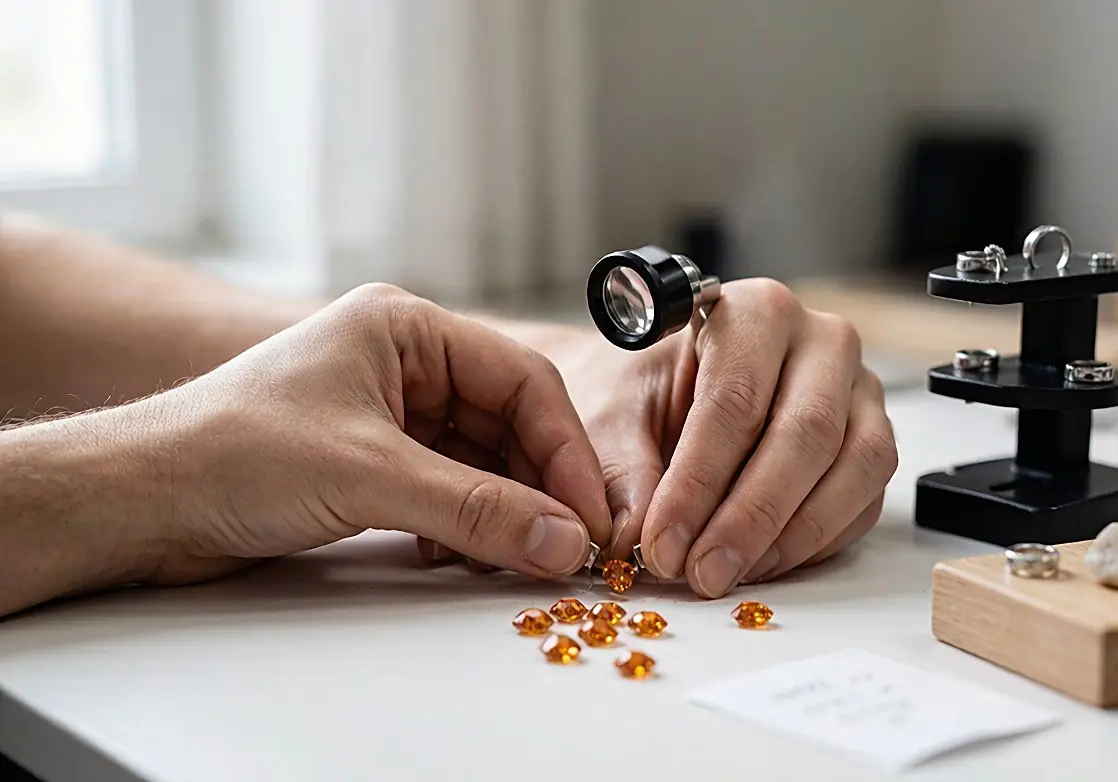
In our production workflow, we do not treat gemstone inspection as a single visual check. We normally look at the stone through several stages:
- Check color consistency – Compare hue, tone, and saturation against the approved sample.
- Check dimensions – Confirm length, width, depth, and calibrated tolerance.
- Check surface condition – Look for chips, abrasions, scratches, or polishing problems.
- Check inclusions and fractures – Pay particular attention to cracks near the girdle or setting area.
- Match stones by color and size – This is essential for earrings and multi-stone designs.
- Confirm treatment information – Record relevant treatment information before production.
- Inspect after setting – Check for chips, movement, uneven prongs, gaps, and surface damage.
GIA’s gemstone durability guidance similarly emphasizes examining stones before setting because fractures or inclusions near vulnerable areas can increase the risk of breakage.
A Factory Experience: Solving a Gemstone Matching Problem
One issue I have encountered repeatedly in production is that a gemstone sample can look perfectly matched under showroom lighting but show obvious differences when hundreds of pieces are inspected together.
On one orange gemstone project, our initial sample used stones with very similar orange color. When the production batch arrived, however, some stones appeared more yellow-orange while others were noticeably reddish-orange. The difference was small when each stone was viewed separately but obvious when the stones were mounted next to one another.
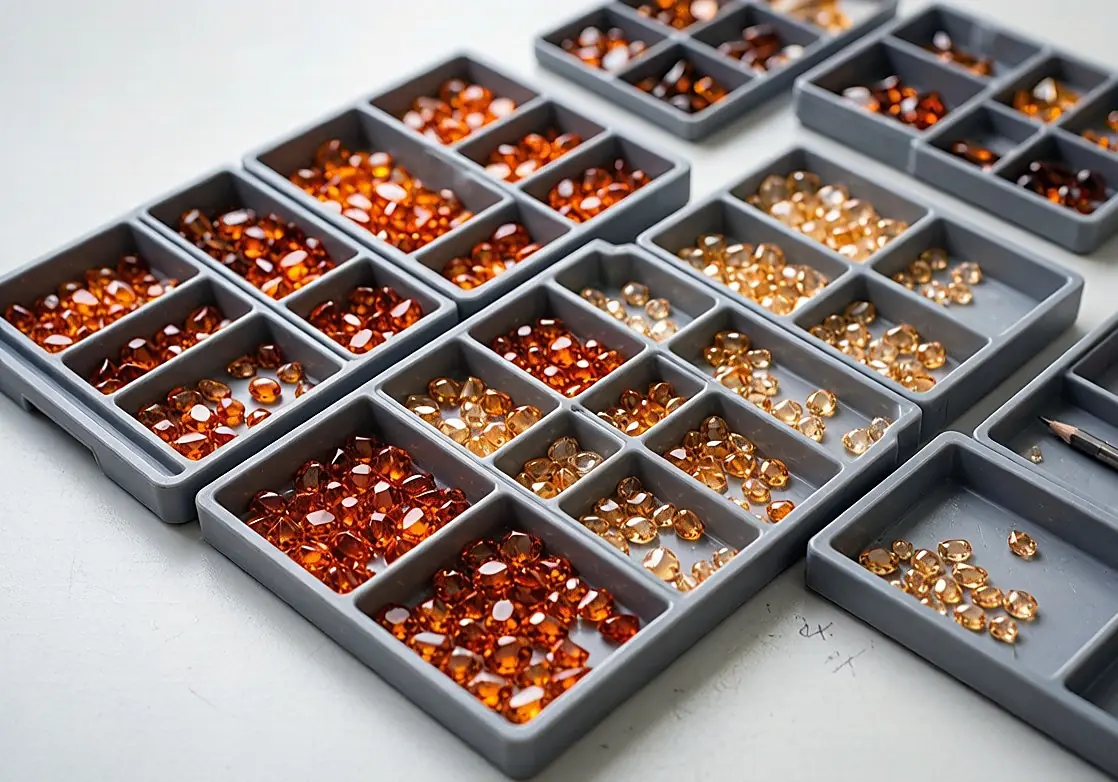
Instead of judging the stones only by the supplier’s color description, we separated them by hue, tone, saturation, dimensions, and clarity. We then created a physical reference set for production and required the replacement stones to stay within that visual range.
We also changed the inspection sequence so that matching was completed before setting rather than after the jewelry had already been assembled. This reduced rework and prevented mismatched stones from reaching final inspection.
That experience reinforced an important manufacturing lesson: gemstone consistency is not only a sourcing issue; it is a production-control issue.
What Makes an Orange Gemstone More Valuable?
The value of an orange gemstone is rarely determined by color alone. Several factors interact to determine its market position.
Color
Color is often the most important factor for colored gemstones.
Buyers should consider:
- Hue
- Tone
- Saturation
- Evenness
- Color zoning
A vivid, attractive orange may command a premium over a brownish or weakly saturated orange within the same gemstone category.
Clarity
Clarity describes the internal and external characteristics of a gemstone.
However, the importance of clarity differs by gemstone. A completely inclusion-free stone is not always necessary or even realistic for certain materials.
Cut
Cut determines how effectively a gemstone interacts with light.
Poor proportions can make even a valuable orange gemstone appear dull. Good cutting can improve brilliance, color distribution, and overall visual balance.
Carat Weight
Larger gemstones are not automatically more valuable. Value often increases nonlinearly as size increases, especially when large stones of high color and clarity are difficult to source.
Origin
For some high-value gemstones, geographic origin can influence market value and desirability. Origin claims should be supported by appropriate documentation rather than assumed from appearance alone.
Treatment
Natural color and treatment status can significantly affect value.
A treated gemstone may be attractive and perfectly suitable for jewelry, but buyers should understand the treatment before comparing its price with untreated material.
Rarity
The rarity of a gemstone can also influence its value, particularly when desirable color, size, clarity, treatment status, and origin occur together.
In most orange gemstones, value is influenced by a combination of color quality, clarity, cut, carat weight, treatment, origin and rarity rather than color alone.
Orange Gemstones for Wholesale and Private Label Jewelry
For wholesale and private label jewelry, gemstone selection involves a different set of priorities from one-off fine jewelry.
A designer may choose one exceptional orange sapphire for a unique piece. A wholesale buyer may need 100, 500, or 1,000 pieces with consistent color, dimensions, and quality.
That changes the sourcing strategy.
Choosing Orange Gemstones for Wholesale Collections
For wholesale collections, I recommend evaluating:
- Supply stability
- MOQ requirements
- Calibrated sizes
- Color consistency
- Replacement availability
- Cutting quality
- Treatment disclosure
- Production yield
- Target retail price
Citrine, carnelian, garnet, and selected tourmaline materials may be practical for different commercial price points, while orange sapphire and fine spinel can be positioned toward higher-value collections.
Choosing Gemstones for Private Label Jewelry
Private label buyers need consistency not only between stones but also between production batches.
A gemstone specification can include:
- Gemstone type
- Color range
- Shape
- Dimensions
- Clarity range
- Treatment status
- Acceptable inclusions
- Matching tolerance
This gives the sourcing and production teams a common reference instead of relying on subjective descriptions such as “bright orange.”
Calibrated vs Free-Size Gemstones
Calibrated gemstones are cut to standard dimensions. They are particularly useful for repeatable production because the setting can be designed around a known size.
Free-size gemstones offer more creative flexibility but can require custom settings for individual stones.
For large wholesale collections, calibrated stones can simplify production and improve repeatability.
Matching Pairs for Earrings
Earring production requires special attention because left and right stones are visually compared immediately.
We normally match:
- Hue
- Tone
- Saturation
- Size
- Shape
- Clarity
- Cut quality
A pair that is technically the same gemstone type can still look mismatched if one stone is more yellow and the other is more red.
Custom Cuts and Custom Jewelry Designs
For OEM and ODM projects, the gemstone can be considered together with the jewelry design from the beginning.
The manufacturer may coordinate:
- Gemstone sourcing
- Custom gemstone dimensions
- CAD design
- Setting structure
- Prototype sampling
- Production
- Quality inspection
- Packaging and private-label requirements
For low-MOQ custom jewelry, the most practical gemstone choice is often the one that balances visual quality, availability, production stability, and target cost rather than the rarest stone available.
How to Care for Orange Gemstone Jewelry
The correct care method depends on the gemstone. There is no universal cleaning method that is safe for every orange gemstone.
Cleaning
For many durable gemstones, warm water, mild soap, and a soft brush are a safe starting point.
However, delicate materials such as amber, coral, moonstone, and opal require additional care. GIA recommends warm soapy water for amber and moonstone and warns against more aggressive cleaning methods for these materials.
Storage
Store gemstones separately whenever possible.
A hard gemstone such as sapphire can scratch a softer material such as amber or coral. Individual pouches or separated jewelry compartments can reduce this risk.
Ultrasonic and Steam Cleaning
Do not assume that ultrasonic or steam cleaning is safe simply because a gemstone is hard.
For example:
- Topaz: avoid ultrasonic and steam cleaning.
- Moonstone: ultrasonic and steam cleaning are not recommended.
- Sunstone: ultrasonic and steam cleaning should be avoided.
- Tourmaline: warm soapy water is recommended instead of ultrasonic or steam cleaning.
- Coral: avoid ultrasonic and steam cleaning.
Which Orange Gemstones Need Extra Care?
The stones that deserve particular attention include:
- Fire opal: relatively soft and contains water.
- Amber: very soft and easily scratched.
- Coral: soft, porous, and sensitive to chemicals.
- Orange moonstone: relatively soft with cleavage.
- Sunstone: moderate hardness with cleavage and relatively poor toughness.
- Imperial topaz: hard but vulnerable because of cleavage.
For these stones, jewelry design and setting protection are just as important as cleaning instructions.
Final Takeaway
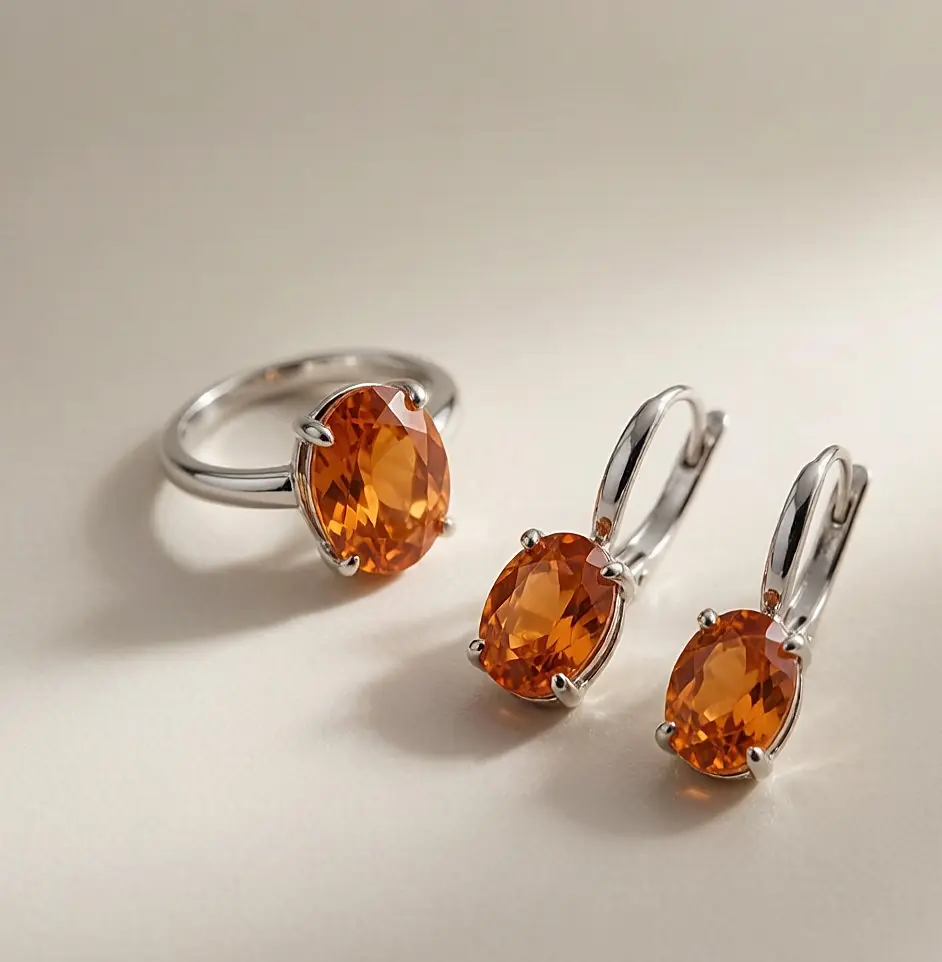
Orange gemstones are not a single material but a broad group of mineral and organic gem materials with very different properties. Orange sapphire, spessartite garnet, imperial topaz, citrine, fire opal, orange spinel, tourmaline, zircon, sunstone, carnelian, hessonite garnet, moonstone, amber, coral, and orange feldspar can all produce attractive orange jewelry, but they are not interchangeable.
For everyday rings, durability should be a primary consideration, making orange sapphire, spinel, and selected garnets particularly practical. Softer or more vulnerable materials such as fire opal, amber, coral, moonstone, and sunstone can be excellent choices for earrings and pendants when protected by suitable settings.
For high-value stones, buyers should also consider certification and treatment disclosure. For wholesale and private-label jewelry, gemstone quality is only part of the decision. Availability, calibrated sizes, color consistency, matching, cutting quality, production yield, and long-term sourcing stability can be equally important.
If you are developing a custom orange gemstone jewelry collection, our jewelry manufacturing team can help with gemstone selection, custom design, sampling, gemstone sourcing, and production support.
Frequently Asked Questions
Popular orange gemstones include citrine, spessartite garnet, orange sapphire, fire opal, orange spinel, imperial topaz, orange tourmaline, sunstone, carnelian, and hessonite garnet. The best choice depends on whether the priority is durability, color, rarity, price, or a particular jewelry application.
Orange sapphire is one of the most durable choices because sapphire ranks 9 on the Mohs scale and has excellent toughness. Orange spinel is another strong option at Mohs 8 with good toughness.
For an everyday ring, orange sapphire is an excellent choice. Orange spinel and spessartite garnet are also practical options. Imperial topaz can be used in rings but requires more attention because its cleavage makes it vulnerable to impact.
Yes. Natural citrine occurs in nature, but it is relatively rare. GIA notes that much of the citrine available commercially is produced by heat-treating amethyst. Citrine can range from pale yellow to brownish orange, with deep orange and reddish-orange shades also available.
Some orange gemstones are relatively affordable, while fine examples can be very expensive. Citrine and carnelian can be accessible choices, while fine orange sapphire, exceptional spessartite garnet, imperial topaz, and rare orange spinel can command substantially higher prices. Value depends on color, clarity, cut, carat weight, treatment, origin, and rarity rather than color alone.
Yes. Orange gemstones can be used in rings, earrings, pendants, bracelets, and other custom jewelry. For custom or private-label projects, the gemstone should be selected together with the setting design, required dimensions, production quantity, matching requirements, treatment information, and target price.